


New High-Speed Nano-D Connector from Omnetics
Omnetics launches its new High-Speed version of the Nano-D connector
In today’s electronic design landscape, balancing miniaturization and performance has become a constant challenge. Devices are increasingly smaller, lighter, and more densely packed, while modern interfaces demand higher data transmission speeds—from high-resolution cameras to PCIe buses, 10 Gbps Ethernet links, or USB 3.0.
Omnetics, a global leader in high-reliability miniature connectors, has introduced a new variant within its Nano-D family: the High-Speed Nano-D. This connector is specifically designed for high-speed applications in demanding environments. It retains the compact size and mechanical robustness that characterize the Nano-D series, but features an internal redesign that enables data rates of up to 20 Gbps per differential pair—without compromising signal integrity, even under shock and vibration.
How does the High-Speed Nano-D differ from the standard Nano-D connector?
Although they share the same external form factor, the High-Speed Nano-D features key internal enhancements to support high-speed digital signals:
- Electrically optimized design for differential signals with controlled impedance (100 Ω ±5 Ω).
- Reduced insertion loss, thanks to a redesigned insulator and optimized pin layout.
- Dedicated differential pairs with specific configurations for high-speed data, which can be combined with discrete signal lines if the design requires.
Both connectors coexist in the catalog: the traditional Nano-D remains ideal for control applications, analog signals, or power delivery, while the High-Speed Nano-D provides a dedicated solution for digital buses and high-frequency protocols.
Key Technical Features of the High-Speed Nano-D Connector
- Data transmission speed: up to 20 Gbps per differential pair.
- Flex Pin contacts: 1 A per contact, compliant with MIL-DTL-32139.
- Preassembled cabling: parallel 30 AWG pairs with high-quality shielding.
- Controlled impedance: 100 Ω ±5 Ω.
- Temperature range: –55 °C to +125 °C.
- Mechanical durability: over 2,000 mating cycles.
- Available configurations: horizontal surface mount (AA) or vertical mount (VV).
- Available cable lengths: from 6 to 108 inches.
- Metal housing: available in anodized aluminum or stainless steel.
- RoHS compliant and low outgassing.
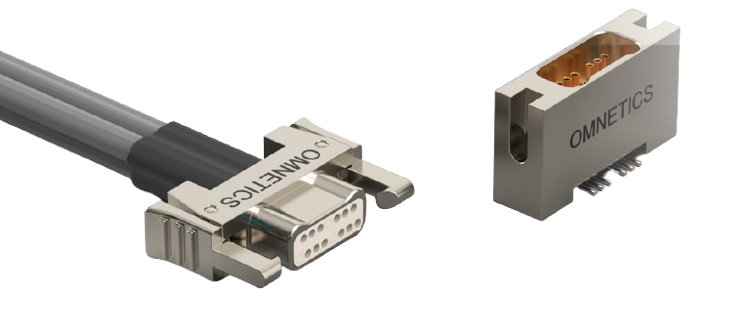
Two versions of the High-Speed Nano-D: HS2 and HS3
To offer greater flexibility to designers, Omnetics introduces two variants within this new range:
High-Speed Nano-D High Density (HS2)

Designed for applications where space is the limiting factor, the HS2 model prioritizes signal density while maintaining solid electrical performance over short-distance links.
- Ideal for embedded cameras, sensors, or miniaturized modules.
- Up to 20 Gbps with a 6” cable and vertical mounting.
- An excellent choice when every millimeter of PCB space matters.

High-Speed Nano-D High Performance (HS3)

Focused on optimal electrical performance, offering lower insertion loss and greater signal stability over longer distances.
- Recommended for PCIe buses, embedded digital communications, or links between modules in edge computing.
- High performance even with 18” cables.
- Ensures signal integrity in more complex architectures.

Advantages of the High-Speed Nano-D in different operating environments
- Machine vision and embedded cameras. Reliable uncompressed video transmission through interfaces like Camera Link or USB 3.0, even in environments with vibration or motion. The compact form factor allows direct integration into drones, robotics, or mobile industrial platforms.
- Onboard communications in defense or aerospace applications. High-speed connectivity between mission-critical modules in UAVs, satellites, or ISR systems, offering vibration resistance and compliance with military standards.
- Portable medical electronics. Diagnostic instrumentation, sensors, or smart probes that require reliable connections, small size, and durability under repeated use. The HS2 enables compact design, while the HS3 ensures medical-grade data transmission without degradation.
- Embedded systems and data acquisition. Data transport via digital buses such as PCIe or Ethernet, with no loss or interference—even in highly integrated designs.
- Edge computing and distributed intelligence. Compact connectors capable of maintaining signal integrity in decentralized architectures, where processors and sensors are distributed and exposed to harsh environmental conditions.