


Flat loss materials for low-frequency applications by Ferroxcube
Flat loss materials for low-frequency applications by Ferroxcube
In many power applications operating at low frequencies—such as switched-mode transformers, filter inductors, or industrial power supplies—one of the main challenges is maintaining high efficiency under varying thermal conditions. Magnetic core losses tend to increase as the temperature moves away from the material’s optimal point, resulting in additional heating, lower system efficiency, and potential long-term performance degradation.
This is especially critical in environments where temperature is not constant: automotive (both in cold climates and under-the-hood conditions), aerospace applications, or industrial equipment operating continuously. This is where flat loss ferrite materials come into play: their more stable thermal behavior helps maintain low and predictable magnetic losses over a wider temperature range, simplifying thermal design and improving overall system efficiency.
Discover the range of MnZn ferrites developed by Ferroxcube—experts in magnetic materials—with flat loss characteristics, tailored to different thermal scenarios. This range currently includes three materials: 3C95, 3C97, and the latest addition, 3C97T. While all three share the feature of thermal stability, each one is optimized for specific operating conditions. Below, we detail the key characteristics of each material:
3C95 – Reliable performance at low temperatures
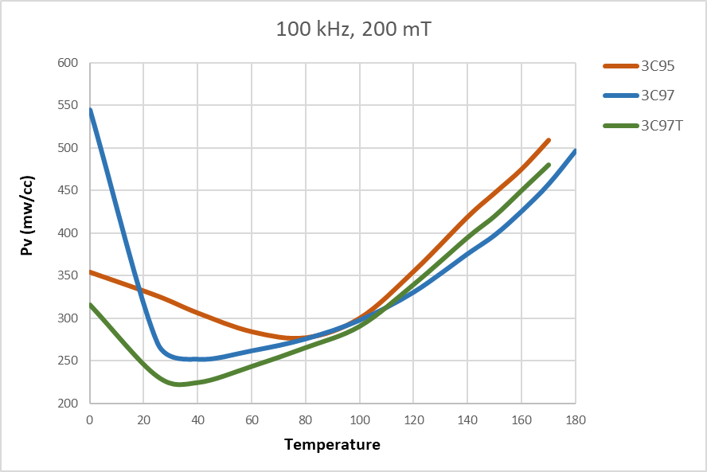
3C95 is the perfect choice when stable behavior is required in low-temperature conditions. Its loss profile remains flat even below –50 °C, with a minimum loss range between 40 °C y 80 °C. This makes it an excellent option for applications such as automotive systems in extreme climates, onboard electronics in aircraft, or outdoor systems that need to operate reliably during winter.
However, at temperatures above 100 °C, the increase in losses becomes more pronounced, making it less suitable for high-temperature environments. Its saturation flux density (Bsat) is also slightly lower than that of the other two materials in the range.
3C97 – High-temperature specialist
At the opposite end is the 3C97, specifically designed to maintain performance in thermally demanding environments. It offers acceptable losses even at temperatures up to 180 °C, and its Bsat is significantly high, allowing for higher flux excursions without saturation. This makes it ideal for under-the-hood applications, industrial power equipment, or converters operating under high thermal load conditions.
Its weakness lies in performance at low temperatures. Below 0 °C, losses increase significantly, which may limit its suitability for applications exposed to cold.
3C97T – Balance between stability and efficiency
The new 3C97T was created precisely to fill the gap between the other two materials. Its main advantage is offering the lowest losses in the range of 0 °C to 100 °C, with a moderate increase below 0 °C and reliable performance up to 140 °C. This gives it great versatility, as it allows maintaining high efficiency both in temperate climates and under moderately demanding conditions.
Like 3C97, it has a high Bsat, making it a good choice for designs that require both efficiency and saturation margin. Although it does not outperform 3C95 in very cold environments nor 3C97 in extreme heat conditions, it achieves a very solid balance for a wide range of applications.
Material comparison and selection
When choosing the most suitable material for a design, it is key to know the thermal profile of the final application. The following table summarizes the behavior of the three materials and their applications:
3C95
It is a ferrite material especially recommended for its performance in cold conditions, with an optimal thermal range from –50 °C to 80 °C. Its magnetic saturation level (Bsat) is medium, and it is commonly used in aerospace applications and automotive in cold climates.
3C97
It stands out for its good performance at high temperatures, operating optimally between 100 °C and 180 °C. It has a high Bsat, making it suitable for demanding environments such as industrial applications or under-the-hood conditions.
3C97T
It offers a balance between thermal performance and stability, with an optimal temperature range of 0 °C to 140 °C and also a high Bsat. It is a versatile option, ideal for designs seeking stable efficiency, such as in general power electronics.
| Material | Punto fuerte principal | Rango térmico óptimo | Bsat | Aplicaciones |
|---|---|---|---|---|
| 3C95 | Rendimiento en frío | –50 °C a 80 °C | Medio | Electrónica embarcada en aeronaves, sistemas de medida en entornos fríos, equipos industriales en exteriores, aplicaciones automotrices en clima extremo |
| 3C97 | Altas temperaturas | 100 °C a 180 °C | Alto | Convertidores de potencia industriales, electrónica bajo capó, controladores de motor en entornos térmicamente exigentes, cargadores de baterías de alta potencia |
| 3C97T | Equilibrio y versatilidad | 0 °C a 140 °C | Alto | Fuentes de alimentación con refrigeración limitada, electrónica de potencia embarcada, inversores solares, maquinaria industrial con variaciones térmicas moderadas |
Consult the official Ferroxcube datasheets.